CO₂ laser — previous method
- Successfully cut the wooden components.
- Edges were heavily blackened.
- Required extensive sanding and finishing.
- Some burnt material had to be removed.
A PM Makerspace project
Discover our xTool F2 Ultra UV experiments cutting selected European and resin-rich hardwoods, and how the results shaped our wooden light boxes.
Made and explored with the xTool F2 Ultra UV laser
Our biggest surprise
Our experience with the UV laser has challenged our expectations of what a small laser can achieve. We’ve experimented with selected European woods and resin-rich tropical hardwoods, and successfully cut wood samples between 3 mm and 6 mm thick.
Some resin-rich tropical woods can be difficult to process on a CO₂ laser because burning, charring and residue affect the finish. In our UV laser experiments, the tested woods came out with much cleaner-looking edges and often needed little or no extra finishing. That is what we observed with our materials, not a promise for every wood or laser setup.
On thinner material, a slight angle on the cut is barely noticeable. On some thicker pieces, particularly between 3 mm and 6 mm, the slope is visible and gives the edge an organic, almost handmade character. We haven’t established what causes the effect, so we treat it as an observed feature of these experiments rather than a guaranteed finish.
A real workshop application
We make illuminated acrylic artwork housed in wooden light boxes. Previously, we cut the wooden components on a CO₂ laser. It worked, but the edges were heavily blackened. Removing the burnt surfaces took substantial sanding and finishing and, in some cases, meant removing more wood than we wanted.
Our experiments with the xTool F2 Ultra UV have produced much cleaner-looking edges on the woods tested, which has substantially reduced the finishing we needed to do in those experiments.
The benefit isn’t simply whether a machine can cut a material. It’s what condition the material is in when the cutting is finished.
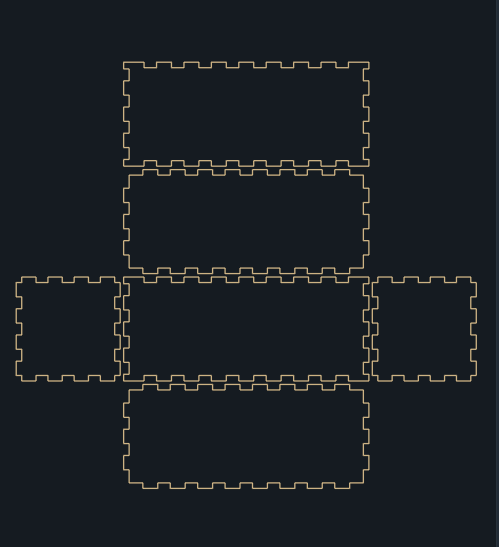
The machine’s working area is relatively small, but we can make a larger wooden light box from separate panels. We cut the components individually and assemble them into a larger structure. The panels use square interlocking joints with a straight, dovetail-like appearance. We make the joints part of the design.